Court Surface Shifts: Tracking Efficiency Changes Across Professional Tennis Tours
Written by Riley Wolf · Jun 30, 2026
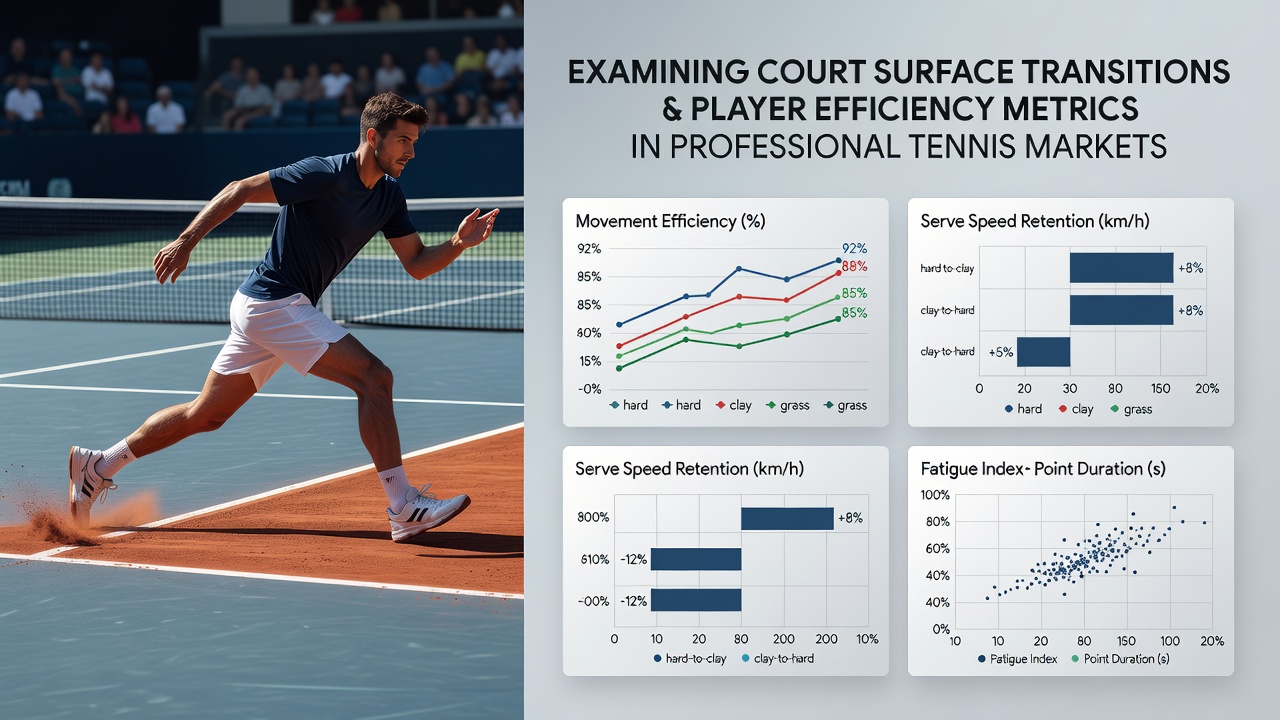
Court Surface Shifts: Tracking Efficiency Changes Across Professional Tennis Tours
Professional tennis schedules force players to move between surfaces multiple times each season, and these transitions create measurable shifts in efficiency metrics such as first-serve percentages, rally lengths, and break-point conversion rates. Organizers place hard-court events in early spring and late summer, clay tournaments throughout the European spring, and grass-court stops clustered around June, which means athletes must adapt quickly to maintain consistent output. Data collected by the ATP and WTA tours shows that players who manage these changes retain higher win percentages on the second surface than those who arrive with minimal preparation time.
Surface Characteristics and Baseline Efficiency Data
Each surface alters ball speed, bounce height, and friction levels in distinct ways, which directly affects how points unfold. Hard courts produce medium-paced bounces that reward balanced all-court games, while clay slows the ball and increases rally duration, and grass accelerates serves yet produces lower, skidding bounces. Researchers tracking ATP matches between 2020 and 2025 found average rally lengths rising from 4.8 shots on grass to 7.2 shots on clay, with corresponding drops in ace percentages from 9.4 percent to 5.1 percent. These baseline differences establish the starting point for measuring how players adjust efficiency when they switch surfaces mid-season.
Adaptation Patterns Observed in 2025-2026 Seasons
Players typically require between seven and ten days to recalibrate stroke mechanics and movement patterns after a surface change. In the lead-up to the June 2026 grass-court swing, several athletes scheduled short clay-to-grass transition blocks in the weeks following the French Open, allowing them to recalibrate footwork and reduce unforced errors on the faster surface. Statistics from teh 2025 season indicated that competitors who inserted at least one dedicated grass practice week improved their serve-win percentages by an average of 3.8 points compared with those who moved directly from clay events.
Key Efficiency Metrics Affected by Transitions
Analysts monitor several indicators to quantify adaptation success. First-serve win rate often dips during the first two matches on a new surface before recovering, while second-serve return points won rise on slower courts because longer rallies provide more opportunities to exploit weaker second deliveries. Break-point conversion shows the largest surface-dependent variance, climbing on clay where defensive retrieval extends rallies and falling on grass where shorter points limit return chances. Tracking these metrics across consecutive tournaments reveals which athletes adjust fastest and which continue to post below-average numbers until later in the swing.

Case Examples from Recent Tours
One European-based player recorded a 68 percent first-serve win rate on indoor hard courts in February 2025 yet saw that figure drop to 61 percent after moving to clay in April, then rebound to 71 percent once the schedule shifted to grass in June. Another competitor maintained stable rally lengths across hard and clay but extended average points by 1.4 shots after arriving on grass, illustrating how surface-specific movement patterns influence efficiency even when overall results remain positive. These individual trajectories align with broader tour data showing that players with prior experience on multiple surfaces experience smaller metric fluctuations during transitions.
Training and Scheduling Influences
Coaching teams now incorporate surface-specific drills earlier in the calendar year to shorten adaptation windows. Sessions that combine high-intensity movement patterns with surface-appropriate ball speeds help athletes preserve serve efficiency and reduce double-fault rates when they change venues. Tournament directors have also adjusted draw sizes and qualifying formats in some events to give main-draw players additional recovery days between surfaces, a change reflected in slightly improved second-week performance numbers during the 2025 clay-to-grass period.
Conclusion
Continued collection of surface-specific efficiency data allows coaches and analysts to identify clear patterns in how quickly players regain peak output after transitions. As schedules maintain their multi-surface structure through the 2026 season and beyond, those patterns provide objective benchmarks for evaluating adaptation success across the professional tours.