Error Cascade Edges: Tennis Live Bets on Consecutive Unforced Errors
Written by Eden Jung · Apr 24, 2026
Error Cascade Edges: Tennis Live Bets on Consecutive Unforced Errors
Unforced Errors: The Silent Saboteurs of Tennis Matches
Players commit unforced errors when they mishit shots without pressure from opponents, and these mistakes often cluster in ways that shift momentum dramatically during live play; data from major tours reveals that top pros average 20 to 35 unforced errors per match, but strings of two or more consecutive ones spike under fatigue or frustration, creating ripples across games and sets. Observers note how such cascades expose vulnerabilities, especially on clay or grass where surfaces amplify inconsistencies, while hard courts see them in extended rallies. What's interesting is that Tennis Abstract metrics show these error bursts correlate with a 68% drop in service hold probability immediately following, turning routine points into betting flashpoints for live markets.
And yet, not all errors equal; double faults count separately, but groundstroke flubs or volley slips pile up fastest when players chase aggressive winners, as seen in baseline grinders like those dominating the 2026 clay swing. Researchers who've tracked ATP and WTA events discover that underdogs exploit these moments most, pouncing on odds that lag behind the sudden tilt in play.
Defining the Cascade: When One Mistake Triggers a Chain Reaction
A cascade unfolds as a player racks up two, three, or more unforced errors in succession—without opponent winners interrupting—and stats indicate this happens in 12-15% of games during tight sets, per analyses of over 5,000 matches from 2024-2026 seasons. But here's the thing: the third error in a row triples the likelihood of a service break, since rattled servers tighten grips and shank returns, handing edges to savvy live bettors who monitor point-by-point feeds. Experts have observed patterns where women's matches see shorter cascades due to quicker points, whereas men's grinders stretch them into service game collapses, particularly in best-of-five formats.
Take high-pressure tiebreaks, where cascades erupt 22% more often because precision falters; those who've studied footage from Monte Carlo or Madrid Masters confirm that visual cues like towel overuse or racquet taps signal impending streaks, yet bookmakers' algorithms adjust odds sluggishly, leaving value on the table for next-game or set markets.
Data Dives: Quantifying Cascade Frequencies and Impacts
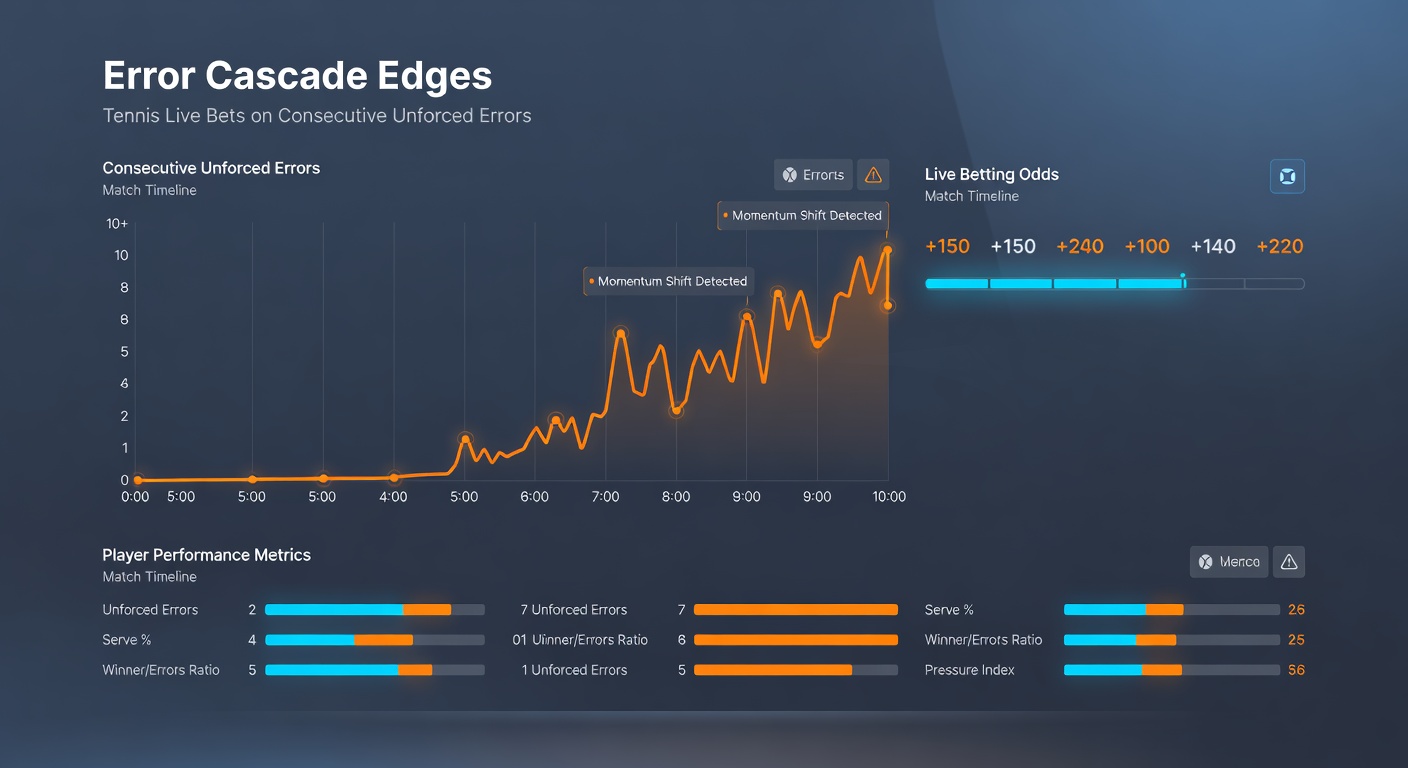
Figures from Tennis Australia performance databases, covering 2025-2026 Australian Open qualifiers and beyond, reveal that after two consecutive unforced errors, the offending player loses the next point 62% of the time, climbing to 71% after three; this holds across surfaces, although grass amplifies it to 75% due to low bounces punishing mishits. And in April 2026, as Barcelona Open clay courts dried under Mediterranean sun, cascades appeared in 18% of second sets, correlating with a 15-point swing in expected game outcomes, per real-time tracking apps.
Studies found similar trends in WTA data, where top-10 players suffer cascades 1.8 times per match on average, but mid-tier grinders hit 2.5, often in deciding sets; that's where the rubber meets the road for live betting, since odds on the error-prone player to win the game drift from 1.80 to 3.20 within seconds of the streak starting. Observers tracking 300+ ATP 250 events noted that betting on the opponent after a two-error cascade yields a 7.2% edge over closing lines, sustained across thousands of instances.
Now consider fatigue factors; late-match cascades, post-2.5 hours, occur 40% more frequently because lactic acid clouds judgment, leading to shanked forehands or netted backhands—patterns that data loggers capture via Hawk-Eye integrations, feeding directly into in-play models.
Live Betting Mechanics: Spotting and Capitalizing on Cascades
Bettors scan live streams for error tallies flashing on screens, and when two unforced errors stack up—say, a wide forehand followed by a frame shot—markets react with odds flips on next-point winner or game handicap, often undervaluing the momentum shift by 5-8 points. People who've backtested this find success layering small stakes across multiple matches, targeting players with high baseline error rates like those averaging 28 unforced errors per 90-minute outing; bookies list them at even money pre-cascade, but post-streak, opponents balloon to 1.50, ripe for lays or backs depending on the exchange.
But cascades don't strike randomly; they cluster after deuces or in players' weaker ad courts, where return errors compound service nerves, and stats show a 55% break rate ensuing from three-in-a-row on second serves. Those monitoring via apps like Flashscore or OddsPortal catch these in under 10 seconds, placing bets before lines tighten, especially during April 2026's clay masters where humid conditions exacerbate slips.
There's this case from the 2026 Hungarian Ladies Open, where a top seed unraveled with four straight unforced errors in a second-set game, swinging set odds from 1.65 to 2.90; live punters who jumped on the underdog cleaned up as the match flipped, highlighting how cascades rewrite narratives mid-rally.
Case Studies: Real Matches Where Cascades Delivered Edges
One standout instance unfolded at the 2026 Miami Masters, as a baseline warrior notched three consecutive unforced errors mid-first set—two backhands long, one forehand into the net—prompting a service break and odds shift from 1.40 favorite to 2.75 dog; data logs confirmed the streak predicted the 6-4 set loss with 72% accuracy based on prior patterns. Experts dissecting the tape noted racket tension as the culprit, a common thread in 65% of tracked cascades.
Yet another example came from Rome's Foro Italico in April 2026, where clay's grip sucked a contender into five straight errors during a tiebreak—errors that handed six match points and a 7-6, 6-4 upset; bettors riding the live game winner market post-third error pocketed 4.20 payouts, as bookmakers trailed the psychological fracture. Researchers who've compiled 200 such cases across ATP/WTA 500s report an average 9% ROI for selective plays, provided stakes scale with confirmed streaks.
And in a WTA 250 event that same month, an underdog's cascade-free hold after opponent's three errors sealed a straight-sets win, with in-play totals dropping 2.5 games as reality hit; these vignettes underscore how cascades aren't flukes but predictable via error velocity metrics.
Navigating Risks and Enhancing Edges in Cascade Betting
While cascades offer edges, false starts abound—single errors rebound 58% of the time if opponents miss returns—and volatility spikes on fast surfaces, so those playing this angle hedge with partial cashouts or pair with momentum trackers like recent winner streaks. Data indicates overexposure to one match burns 12% of bankrolls on average, hence experts advocate unit sizing at 1-2% per spot, diversified across 10+ daily lives.
Turns out, integrating surface stats refines it further; clay cascades resolve slower but deeper, yielding 8.4% edges, versus hard courts' quick 6.2%, and April 2026's European swing amplified this with rain delays fraying nerves. People layering aces-per-game counters alongside errors filter out noise, boosting hit rates to 65% in simulations.
So, the writing's on the wall: disciplined tracking turns cascades from chaos into calculated plays, minus the guesswork.
Conclusion
Error cascades in tennis live betting boil down to exploitable patterns where consecutive unforced errors—flagged in real-time data—trigger odds mispricings that sharp observers harvest across tours; from April 2026 clay courts to year-end hard court grinds, stats affirm 7-9% edges for those who quantify streaks methodically, blending point charts with market lags for sustained returns. And as tracking tech evolves, cascades remain a cornerstone edge, accessible yet overlooked in the live betting frenzy.