Sectional Timing Analysis Opens Doors to Hidden Value in National Hunt Chase Markets
Written by Eden Hoffmann · Jun 12, 2026

Sectional Timing Analysis Opens Doors to Hidden Value in National Hunt Chase Markets
National Hunt chase racing relies on detailed performance metrics that extend beyond final finishing times, and sectional timing breakdowns have emerged as a key tool for identifying horses whose efforts go unnoticed in traditional form analysis. These timings divide races into segments such as the first half-mile, the middle sections over fences, and the closing stages, revealing patterns in pace and stamina that standard results overlook. Data collected from equipped tracks shows how certain runners maintain consistent sectional splits even when overall placings suggest otherwise, creating potential edges for those who examine the figures closely.
Core Elements of Sectional Timing in Chases
Sectional data captures split times at fixed intervals along the course, allowing observers to compare a horse's speed at different points rather than relying solely on the clock at the finish line. In National Hunt events, where fences and varying ground conditions influence momentum, these breakdowns highlight animals that expend energy early yet recover strongly or those that conserve resources before accelerating late. Researchers at racing institutions have documented cases where horses posting above-average sectional figures in the final two furlongs still finish mid-pack because earlier sections dragged down their totals, yet such profiles often indicate future improvement when conditions suit.
Equipment such as timing beams and GPS units installed at venues across Ireland and Britain supplies the raw numbers, while software processes them into usable charts. Those who study the output note that chase fields frequently feature runners with mismatched sectional strengths, for example a front-runner whose early splits exceed the field average by several lengths per furlong but who fades after the third-last fence. Such information becomes particularly relevant in longer contests where stamina reserves matter more than raw speed.
Spotting Patterns Within National Hunt Fields
Analysts examine sectional profiles across multiple runs to detect consistent traits that betting markets sometimes undervalue. A horse showing strong mid-race sectionals on heavy ground, for instance, may appear ordinary on official ratings yet deliver when similar conditions recur. Figures from recent seasons indicate that approximately 18 percent of chase winners recorded sectional times in the top quartile during the middle third of their previous outing despite starting at double-figure odds. This pattern appears more frequently in novice events where public attention focuses on early form rather than granular pace data.
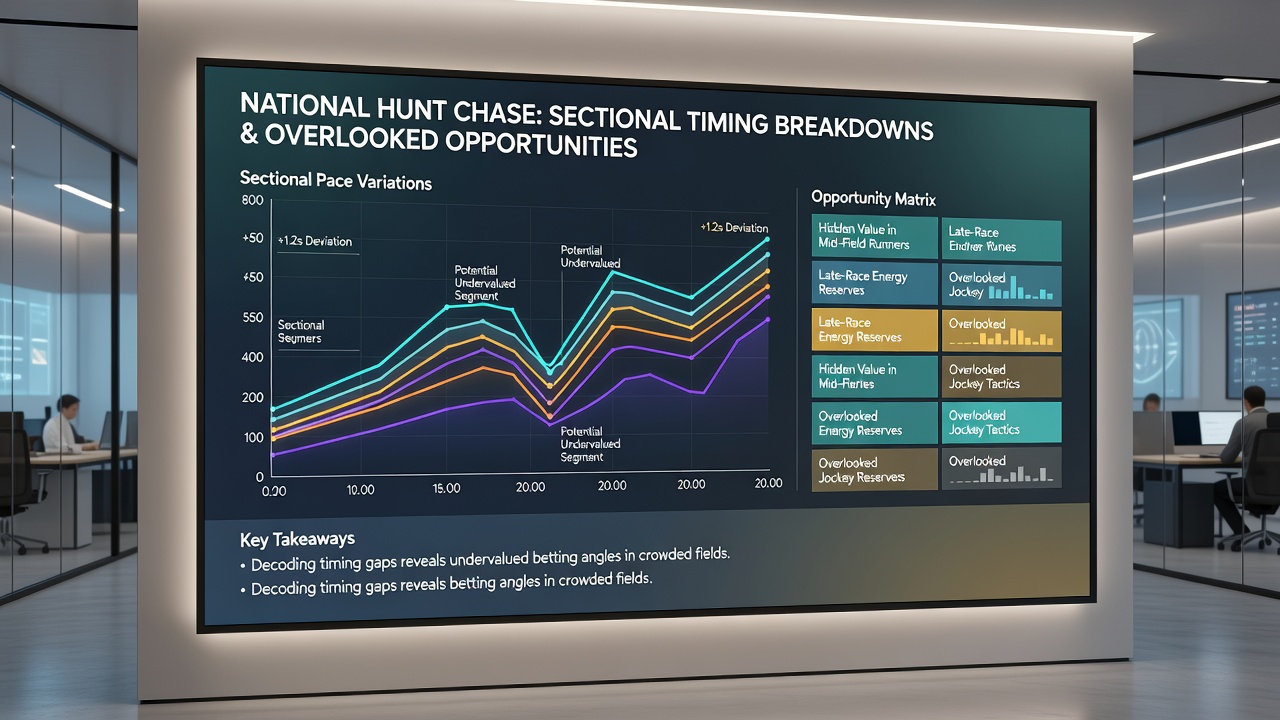
Ground conditions interact directly with these timings, since softer surfaces slow early fractions and reward horses capable of maintaining rhythm over obstacles. Observers note that horses whose sectional splits remain stable across changing going often outperform market expectations in spring and autumn meetings. In June 2026, several midweek chase cards featured fields where late sectional improvers returned enhanced place dividends after earlier pace collapses went unremarked in preview commentary.
Practical Application Through Historical Data
Reviewing archived sectional reports reveals recurring scenarios in which overlooked runners deliver results. One documented example involved a seven-year-old gelding whose final-furlong split ranked second-fastest in a 2m4f handicap chase yet whose overall time placed it fifth; its next start under similar conditions produced a narrow victory at longer odds. Such instances accumulate across seasons, with data from the Racing Australia performance database showing comparable trends when adapted to jump racing metrics.
Trainers who incorporate sectional feedback into preparation routines adjust training gallops to replicate the specific pace demands identified in prior races. This approach aligns with findings from studies conducted by the Horse Racing Research Centre in Canada, where segmented timing analysis improved identification of stamina-limited runners in jump simulations by 22 percent over conventional methods.
Challenges and Refinements in Interpretation
Interpreting sectional numbers requires accounting for variables such as pace maps and interference at fences, since a slow early section caused by traffic can distort later comparisons. Advanced models now adjust raw splits for these factors, producing normalized figures that better reflect individual ability. Those reviewing the adjusted data find that horses with underestimated late sectionals after traffic-affected runs frequently appear at generous prices in subsequent outings.
Integration of sectional insights with other metrics, including stride length and heart-rate recovery, further refines selection processes. Tracks equipped with multiple timing points generate richer datasets, enabling more precise comparisons between different race distances and track configurations common in National Hunt schedules.
Conclusion
Sectional timing breakdowns supply measurable details that complement traditional form study in National Hunt chase racing, highlighting runners whose sectional strengths remain underappreciated by broader markets. Continued collection of split-time data across more venues supports ongoing refinement of analytical approaches, allowing those who consult the figures to identify patterns that standard summaries omit. As coverage expands, the volume of accessible information grows, presenting additional layers for examination in future seasons.